What is lateral thinking?
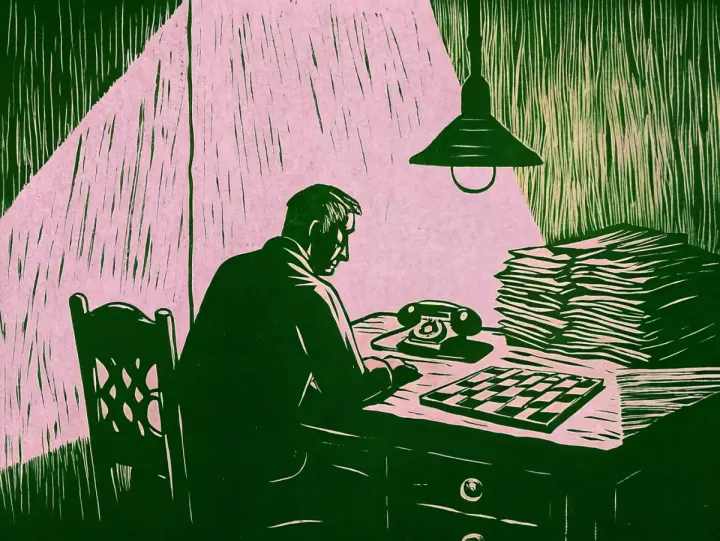
The term "lateral thinking" was coined by creativity researcher Edward de Bono. It describes a way of thinking that doesn't march straight ahead step by step, but deliberately takes detours, questions assumptions and tries out unusual perspectives.
In everyday language we call it "thinking outside the box". Its counterpart is vertical or linear thinking: you follow the most obvious explanation and build on it logically. That often works well – but not when the obvious explanation is wrong.
Situation puzzles (also known as lateral thinking puzzles or yes/no riddles) are built on exactly that. The opening scenario nudges you towards a reading that leads you astray. You can only crack it once you spot the silent assumption you've made and throw it overboard.
Why situation puzzles are great brain training
In a situation puzzle you start with very little information and have to decide for yourself what to find out next. That trains several skills at once: forming hypotheses, asking targeted questions, interpreting answers correctly and dropping theories when they no longer fit.
It's less about knowledge than about flexibility. You learn not to get stuck on your first idea, and you notice how many assumptions can hide in a single sentence.
Mental fitness works like sport: consistency is what counts. One puzzle a day, on the way home or before bed, keeps your mind nimble – and it's far more fun than dry memory drills.
Tips: how to ask better questions
Work from big to small. Start with questions that rule out many possibilities at once: Did someone die? Was it intentional? Does the time of day matter? Only then go into detail.
Examine every word of the opening scenario. Ask specifically about terms that could be ambiguous. A word you automatically understood one way may mean something completely different.
Put your assumptions to the test. Ask explicitly about the things you take for granted: Are the people alone? Does it all happen on the same day? Is the obvious reading really the intended one?
Use every type of answer. "Irrelevant" crosses off a trail, "Partly" tells you that only part of your question is right – so break it down into smaller questions.
How to train with What happened?
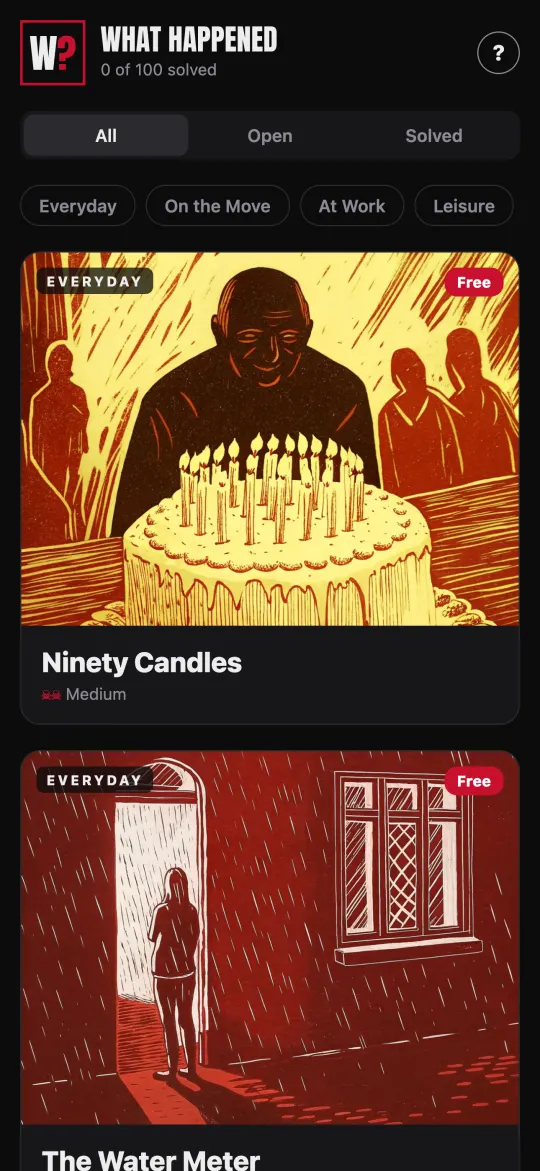
In the app, an AI game master takes on the role you'd otherwise need a second person for. It knows the solution to every story and answers with Yes, No, Partly, Irrelevant or "Not a yes/no question". That last one helps you phrase your questions cleanly.
You can type your questions or speak them. So you can train on your own and in short breaks too.
Every story has key facts you need to work out. That gives you clear feedback on whether you've really understood the story or are only roughly on the right track.
Three difficulty levels let you build up: start with the easier cases and work your way towards the tricky ones. Try the examples below to see how far your lateral thinking takes you already.