Why lateral thinking puzzles work at parties
Plenty of party games need prep: shuffle the cards, explain the rules, split into teams. Lateral thinking puzzles start in seconds. The rule fits into one sentence: ask questions that can be answered with yes or no.
The format is wide open. People can join late, wander off to the fridge, or just listen for a while and then drop the one question that breaks the case wide open. Nobody gets eliminated, nobody is stuck watching from the sidelines.
And the stories give you something to talk about. The situations are dark and blackly funny, the solutions as surprising as they are logical. Once the case is solved, the table usually keeps arguing about who was on the right track early on — and whose wildest theory was furthest off.
How to play in party mode
The group mode in What happened? is built for a room full of people and works without internet and without AI.
1. Pick one person as the host. They choose a story and read the solution silently on the phone.
2. The host reads the mysterious situation out loud.
3. Everyone else asks yes/no questions. The host answers with Yes, No, Partly or Irrelevant.
4. Anyone who thinks they have it tells their version. The case is solved once all the key facts of the story have been guessed.
Then the host passes the phone on and the next person takes over. That way everyone gets a turn at making the rest of the group squirm.
Variants for your game night
Team duel: split into two groups. Both work on the same story in turns, one question per team per round. The first team to name all the key facts takes the point.
Question limit: agree on how many questions are allowed, say 20. It forces everyone to think before blurting out the next question.
Silent round: everyone writes their theory on a slip of paper before the solution is revealed. Whoever came closest picks the next story.
Everyone against the AI: use the AI host instead of party mode. Then nobody knows the solution and the whole group puzzles it out together. One person types or speaks the questions. Perfect when nobody wants to sit out the guessing.
Great for flat-share nights and small groups
Not every evening is a big party. What happened? works just as well with three people around the kitchen table, because yes/no puzzles don't need a crowd to be fun.
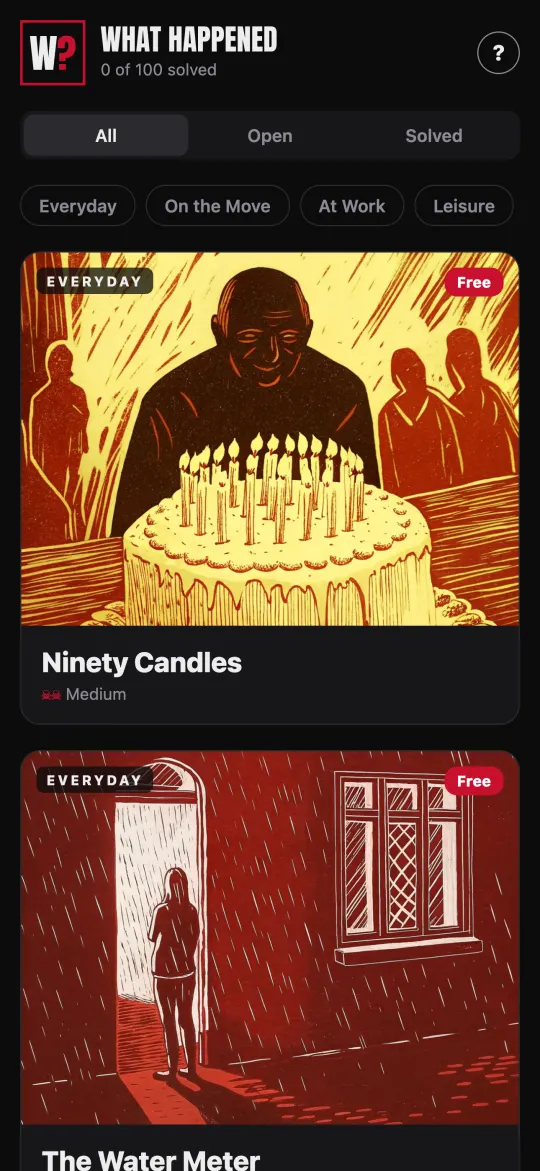
The 100 stories are spread across the packs Everyday Life, On the Road, Work and Leisure. If you play together regularly, you can work your way through the different themes. Three difficulty levels make sure that newcomers and seasoned puzzle fans both get their money's worth.
Handy for shared evenings: there's no account and no ads to break the tension at the worst moment. Packs you buy are yours with no subscription — €2.99 per pack or €7.99 for all of them. The 12 free stories are plenty to get a taste.
Tips for a good host
Read the solution carefully before you read out the situation. You need to really understand the story to answer every question correctly.
Keep your answers short. A clean yes or no beats a comment that accidentally gives too much away. For questions that lead nowhere, say "Irrelevant" — it helps the group more than you'd think.
If everyone is stuck, you're allowed to nudge them: repeat the opening situation or sum up what's already known. That's often enough to open up a new direction.
Read the room: the stories are dark and better suited to ages 12 and up. Try the examples below to get a feel for the tone.